
Background
Achieving gender equality is crucial for poverty eradication, economic growth, and social development.
The global picture
Gender inequality is a pervasive and multifaceted issue that affects societies worldwide. It is a fundamental violation of human rights and a barrier to achieving sustainable development. Gender inequality persists across the globe, impeding progress in various spheres of life.
According to the World Economic Forum’s Global Gender Gap Report 2020, the average global gender gap stands at 68%. This means that, on average, women have only attained 18% of the rights and opportunities available to men. These disparities are evident in statistics such as the global gender wage gap, which stands at 16%, with women earning less than men for the same work.
Women’s limited access to education is another area of concern. Although significant progress has been made, particularly in primary education, gender gaps persist at secondary and tertiary levels. Furthermore, women face higher rates of maternal mortality and limited access to healthcare services compared to men.
Nepal’s gender gap
In Nepal, despite efforts to promote gender equality, significant challenges persist. Nepali women face limited access to education and healthcare, early marriage, gender-based violence, and restricted participation in decision-making processes. Recognizing the importance of gender equality, Nepal has taken significant steps to address gender inequality. The country introduced legal frameworks, such as the Gender Equality Act (2006) and the National Women’s Commission Act (2007), to protect women’s rights and promote gender equality. Additionally, Nepal is a signatory to international agreements and conventions that aim to eliminate gender discrimination.
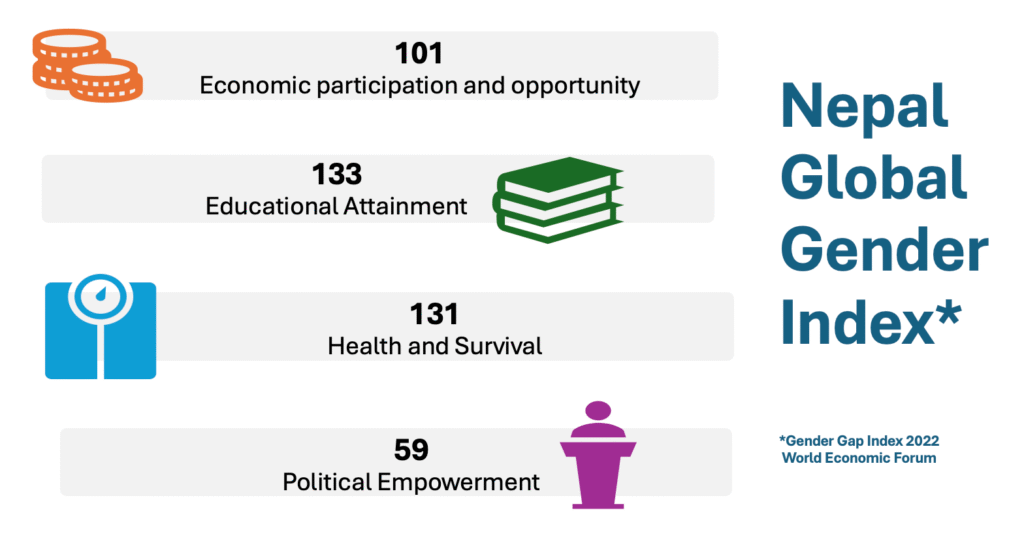
Global Gender Gap Index 2022
Where Nepal ranks among 146 countries
A lower number is a smaller gap. Nepal ranks in the top half for political empowerment and near the bottom for education and health.
Economic participation & opportunity
101of 146Labour-force participation, wages, senior rolesEducational attainment
133of 146Literacy and enrolment at every levelHealth & survival
131of 146Sex ratio at birth and healthy life expectancyPolitical empowerment
59of 146Women in parliament and ministerial positionsThe Nepalese government has implemented various initiatives to empower women and girls. For instance, programs like the National Women’s Empowerment Fund and the Female Community Health Volunteer Program provide financial support and promote women’s involvement in healthcare delivery. Furthermore, Nepal has made considerable progress in increasing women’s political representation, with women now constituting 33% of the national parliament. However, gender inequality continues to be both a national and a global challenge that requires comprehensive efforts to achieve sustainable development. Despite advancements, gender disparities persist in various aspects of life, including education, employment, health, and decision-making processes. Nepal’s case demonstrates both the challenges and the progress in addressing gender inequality.
To make substantial progress, it is essential for governments, civil society organizations, and individuals to work collaboratively. Implementing and enforcing gender-sensitive policies, investing in education and healthcare for women and girls, and promoting women’s empowerment and leadership are critical steps in achieving gender equality. Only by addressing gender inequality comprehensively can societies create a more just, inclusive, and prosperous future for all. This is where WEI comes in.
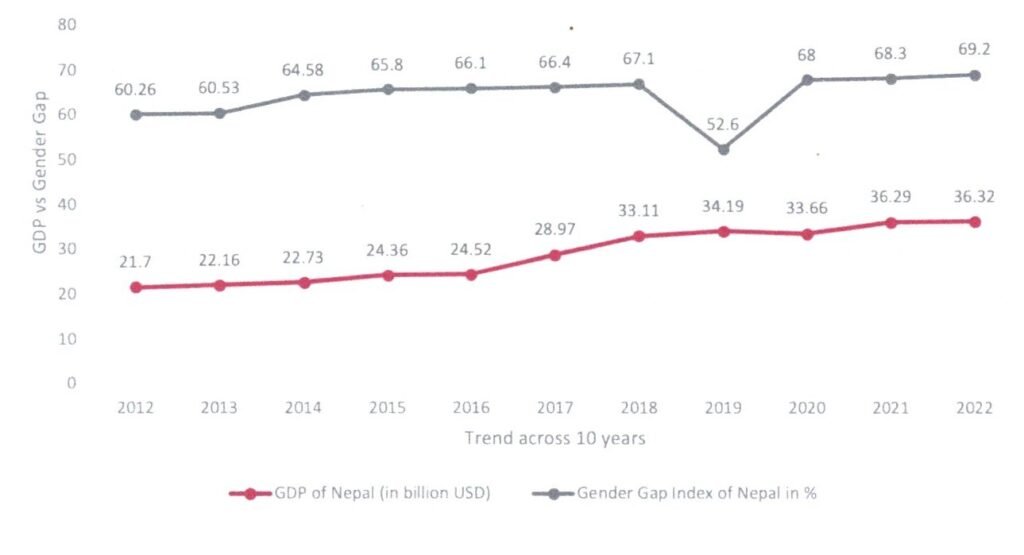
Growth without equity
Nepal's economy has grown steadily for a decade. Its gender gap index has barely moved, and fell sharply in 2019.
Sources: World Economic Forum Global Gender Gap reports 2012–2022; World Bank GDP (current US$).
Seven barriers women in Nepal face
1. Women face barriers to accessing leadership positions and decision-making roles in various sectors, including politics, businesses, and community organizations hinders women’s participation and influence in shaping policies and programs.
2. Traditional cultural norms and gender roles often reinforce inequalities and limit women’s opportunities. Social expectations, stereotypes, and discriminatory practices create barriers for women in education, employment, and societal engagement, restricting their agency and autonomy.
3. Women in Nepal face safety challenges, including domestic violence, sexual harassment, and trafficking. Lack of safe public spaces, social stigma, and inadequate support systems further exacerbate the vulnerability of women to violence and restrict their freedom of movement and participation in society.
4. Women in Nepal encounter barriers to accessing work opportunities, fair wages, and economic resources. Discriminatory practices in the workplace, such as unequal pay and limited career advancement, contribute to economic disparities and hinder women’s financial independence and empowerment.
5. Women’s health and well-being are affected by multiple factors, including limited access to quality healthcare services, inadequate reproductive healthcare and rights, high maternal mortality ratios, and malnutrition. Gender biases and cultural practices also impact women’s access to healthcare and contribute to health disparities.
6. Despite progress in education, girls and women still face challenges in accessing quality education, particularly in rural areas. Factors such as child marriage, gender stereotypes, and inadequate infrastructure hinder girls’ education and limit their opportunities for skill development and lifelong learning.
7. The gender digital divide exists in Nepal, with women having limited access to and utilization of information and communication technologies (ICT). This limits their ability to benefit from digital resources, including online education, entrepreneurship opportunities, and access to information and services.
What stands in the way
Seven barriers women in Nepal face
The gaps behind the numbers above, and the ground our programs are built on.
Leadership
Women are under-represented in politics, business and community decision-making.
Cultural norms
Traditional gender roles limit women's choices in education, work and public life.
Safety
Domestic violence, harassment and trafficking restrict women's movement and participation.
Fair work
Unequal pay and blocked advancement keep women financially dependent.
Health
Limited reproductive care, high maternal mortality and malnutrition affect women's well-being.
Education
Child marriage and gender stereotypes keep girls, especially rural girls, out of school.
Digital divide
Limited access to technology cuts women off from information, learning and enterprise.